

Case file 01 · Hii NYC · Brooklyn
Hii NYC:
8 number ones,
two boroughs
Williamsburg and Bay Ridge. A brutally crowded dispensary map and its quietest corner, and on July 1, 2026 the board read the same in both: Hii NYC, position one. Eleven days later, Perplexity led its tracked Brooklyn answers with the same name.
8
number-one keywords, scan 2026-07-01
319,553
June impressions, +53.8% (GSC)
+32.9%
Q2 clicks vs Q1 (GSC)
1st
Perplexity recommendation, 2026-07-12
Hii NYC is a licensed adult-use cannabis dispensary with stores on Bedford Avenue, Williamsburg and 3rd Avenue, Bay Ridge. Bud Authority rebuilt hiinyc.com on Next.js in April 2026, shipped Apex MenuEdge live-menu infrastructure in May, and runs its local and AI-search program under continuous Sentinel monitoring.
The nameplate
- Market
- Williamsburg + Bay Ridge, Brooklyn
- Live site
- hiinyc.com
- Program
- Build + SEO + AEO + MenuEdge
The site behind the numbers
What the rankings point at
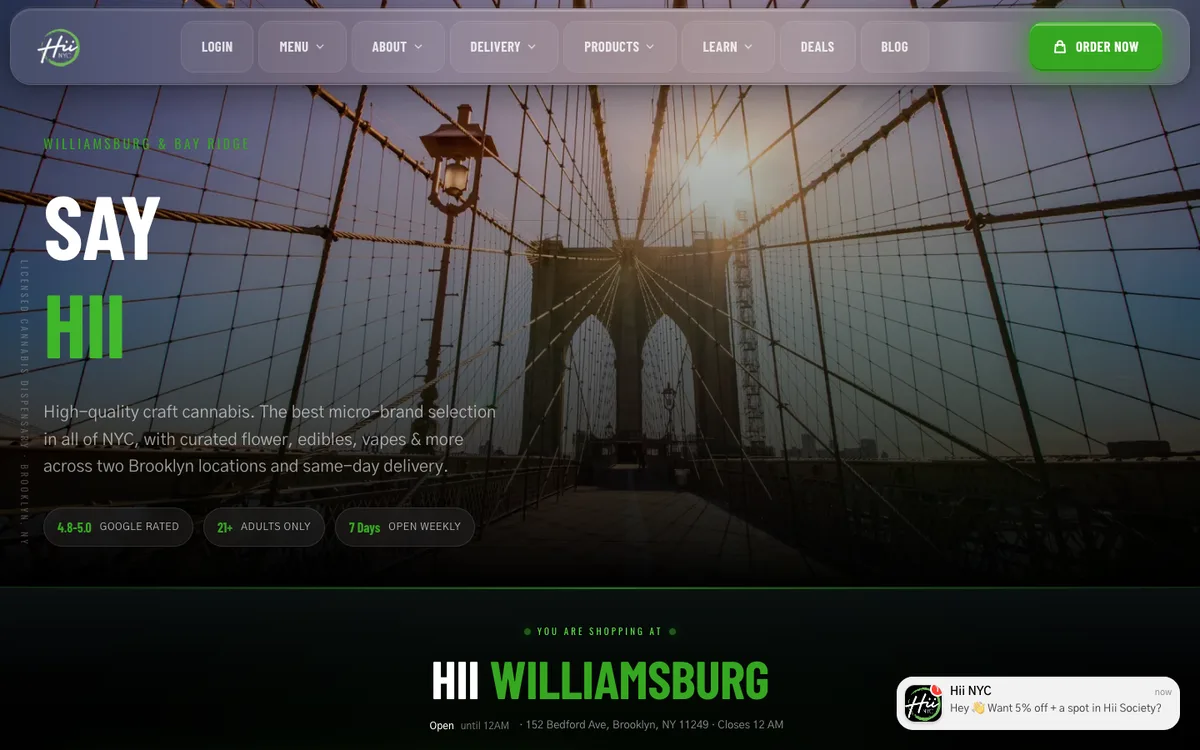
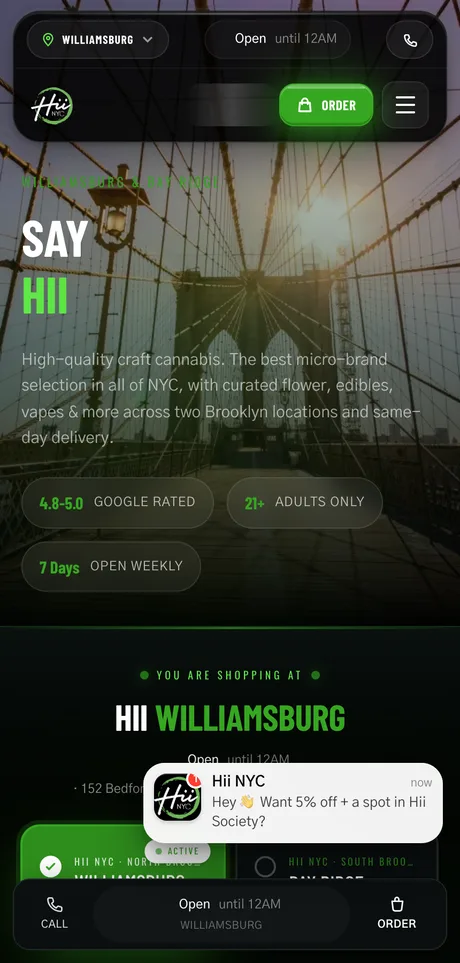
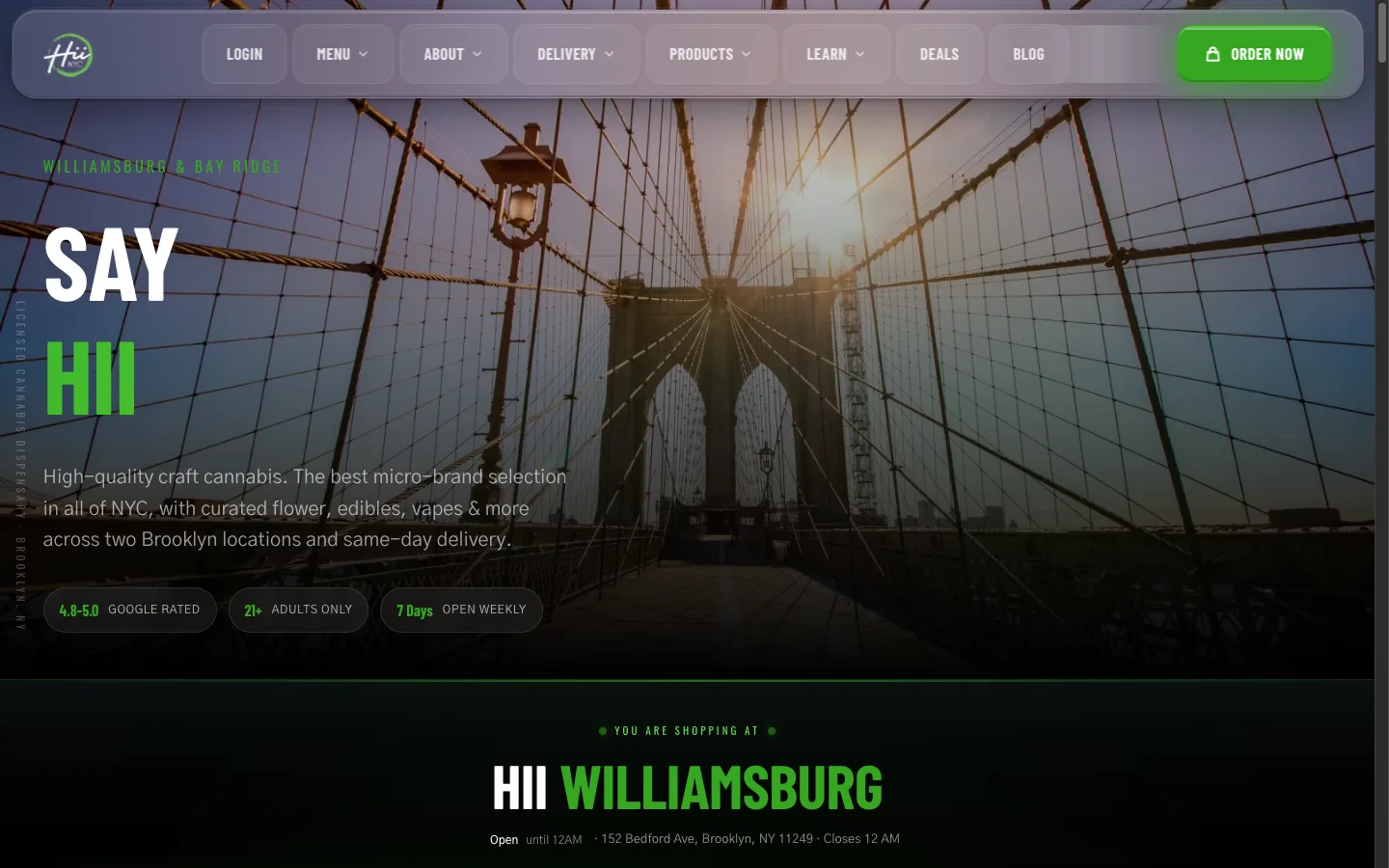
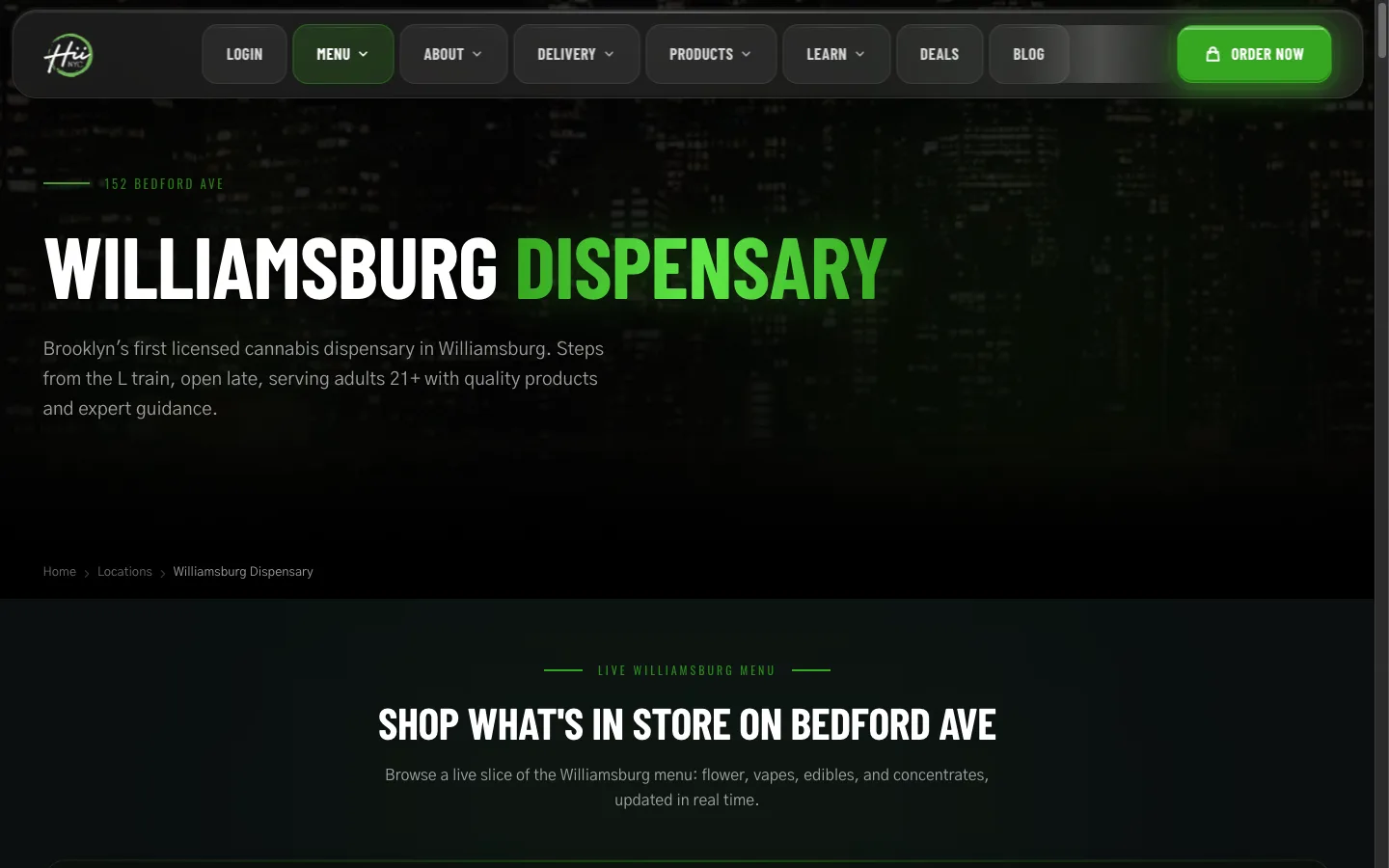
The Next.js rebuild of hiinyc.com, desktop and mobile. Every number on this page resolves to this site, and it's one tap from the live thing.
8×
tracked keywords held at number one across Williamsburg and Bay Ridge at the July 1, 2026 Sentinel scan
- “bay ridge dispensary”#1Bay Ridge
- “dispensary bay ridge”#1Bay Ridge
- “williamsburg dispensary”#1Williamsburg
- “dispensary williamsburg”#1Williamsburg
- “best dispensary williamsburg”#1Williamsburg
- “dispensary bedford ave”#1Williamsburg
- “pre rolls williamsburg”#1Williamsburg
7 of the 8 number-one receipts named above; the 8th is grid coverage: Bay Ridge top spot on 38 of 49 pins, top-3 on all 49 (Sentinel geo-grid, scan 2026-07-01)

The map, not one address
Number one across the grid
A single ranking is one point. This is the whole Bay Ridge scan grid for “dispensary near me” on July 1, 2026, coloured by where Hii NYC actually sat in Google's Maps pack at each point on the map.
7×7 scan grid · each cell = Google Maps rank at that point
Maps-pack grid
“dispensary near me” around Bay Ridge, Brooklyn
11/49
scan points at #1
29/49
in the top three
The machine answer
Ask an AI where to buy in Brooklyn.
Read what it says back.
> provider: perplexity
> tracked prompts: 3 · mentioned: 2 · majority: true
> recommendation order: Hii NYC, first
> appearances: 4 · is_ours: true

Somewhere in Brooklyn, a screen just went green. It stays green because someone is watching it.
The receipts
Every number, stamped
GSC clicks, July 2026
3,795+0.4%Sentinel get_client_summary / GSC (pulled 2026-09-01) · 2026-07 vs prior periodAI answers recommending Hii NYC, Brooklyn prompts
64 of 120Sentinel get_ai_visibility · AI-visibility pass 2026-08-15Search impressions, June 2026
319,553+53.8%Sentinel / GSC (get_client_summary) · 2026-06-01 to 2026-06-30 vs prior periodGSC clicks, Q2 2026
10,305+32.9%GSC via verified Q2 QBR (2026-07-08) · Q2 2026 vs Q1 2026GSC clicks, June 2026
3,644+31.7%GSC via verified Q2 QBR (2026-07-08) · June 2026 vs June 2025 (clicks-only YoY)Perplexity recommendation rank
first recommendation, 2 of 3 tracked promptsSentinel get_ai_visibility (best_order 1, mentioned_majority true) · AI visibility pass 2026-07-12Menu pages indexed after Apex MenuEdge launch
1,532verified Q2 QBR (2026-07-08) · by June 2026 (launch 2026-05-14)Search impressions, July 2026
267,361Sentinel get_client_summary / GSC (pulled 2026-09-01) · 2026-07
Windows and sources render with each figure. Q2 clicks and the June YoY line come from the adversarially verified Q2 2026 QBR; checkout completes inside the embedded menu, outside GA4's view, so order-intent handoffs are the closest countable conversion step.
Every surface a search happens on
Found first, where it counts
Google Maps, organic search, and the AI answer engines shoppers now ask by name. Here is where Hii NYC actually sits on each, measured and dated.
Google search impressions
+53.8%
AI search visibility · Perplexity
#1
recommendation order for Hii NYC
2/3
tracked prompts named the brand
When a shopper asks Perplexity where to buy, Hii NYC is named in 2 of 3 tracked prompts and leads the answer where it appears.

On the record
The Hii NYC file, on the record
- What did Bud Authority build for Hii NYC?
- A full Next.js replacement for the previous WordPress site (relaunched April 2026), Apex MenuEdge live-menu infrastructure that put 1,532 menu pages into Google's index by June, borough-level local SEO for Williamsburg and Bay Ridge, and the AEO layer Perplexity cited in the July 2026 visibility pass.
- Which rankings did Hii NYC hold at the July 2026 scan?
- Eight tracked keywords at number one across both boroughs, including bay ridge dispensary, williamsburg dispensary, best dispensary williamsburg, dispensary bedford ave, and pre rolls williamsburg. Sentinel rank scan, July 1, 2026.
- What does the Perplexity result actually mean?
- In the July 12, 2026 AI-visibility pass, Perplexity named Hii NYC in 2 of 3 tracked Brooklyn dispensary prompts and placed it as the first recommendation where it appeared. When a customer asks an AI engine where to buy in Williamsburg, Hii NYC is the answer it leads with.
- How competitive is this market?
- At the July 1, 2026 Sentinel maps-pack scan for dispensary near me, the Williamsburg grid tracked 15 competing dispensaries and left every player with single-digit share of local voice, Hii included at 2.0 percent. Bay Ridge is the flipped picture: 15.3 percent share of local voice and position one on 38 of 49 grid pins. Two boroughs, two completely different battles, one operator holding rankings in both.

Your board can go green too.
Every number on this page has a date and a source. Audit us.